2008, June 4. Department of Science and Technology (DOST), 50th Anniversary
Litho Offset. Amstar Company, Inc. Perf. 14.
Singles, Sheets of 50 (5 x 10)

7p Department of Science and Technology - Singles (60,000)
Designer and Layout Artist: Benedict Cagaanan
Design Coordinator: Victoria B. Bartilet
Text by: Rodel G. Offemaria, Fe Medina
Over-all-Director: Carol M. Yorobe
First Day Covers: Manila
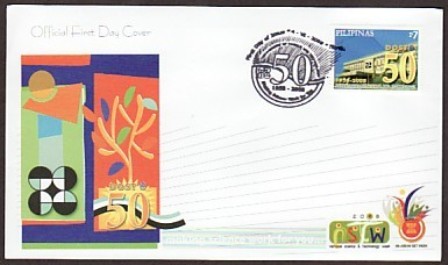
Department of Science and Technology (DOST), and,
Philippine Nuclear Research Institute (PNRI), 50th Anniversaries
It was in 1958 when the Philippine Congress passed a law for the creation of the National Science Development Board (NSDB). Essentially, the National Science Development Board laid down the foundation stones of an organized national scientific development effort.
In 1982, the NSDB was overhauled into the National Science and Technology Authority (NSTA) to assume broader policy making and program implementing functions. The expanded structure was an attempt to meet the period's emergent development and competitive challenges.
Five years later, the NSTA was upgraded into its current structure following a powerful social upheaval celebrated in its non-violent temperament. The Department of Science and Technology (DOST) was created with fresh hopes of accelerating the development and deployment of technology products and services appropriate to the needs of domestic industries including SMEs.
-
Science
-
Government Institutions