2009, June 2. Philippine Birds - Definitives (Reprints 2009A)
Litho Offset. Amstar Company, Inc. Perf. 13.5
Singles, Sheets of 100 (10 x 10)
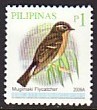
1p Mugimaki Flycatcher - Singles (700,000)
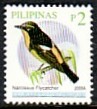
2p Narcissus Flycatcher - Singles (400,000)
Designs: All pictures taken from the book "A Guide to the Birds of the Philippines" by Robert S. Kennedy, Pedro C. Gonzales, Edward C. Dickinson, Hector C. Miranda, Jr., and Timothy H. Fisher.
First Day Covers: Manila
1p - The Mugimaki Flycatcher (Ficedula mugimaki). A small passerine bird of eastern Asia belonging to the genus Ficedula in the Old World flycatcher family, Muscicapidae. The name "mugimaki" comes from Japanese and means "wheat-sower". The bird is also known as the Robin Flycatcher. It is 13 to 13.5 centimeters long. It has a rattling call and often flicks its wings and tail. The adult male has blackish upperparts with a short white supercilium behind the eye, a white wing-patch, white edges to the tertials and white at the base of the outer tail-feathers. The breast and throat are orange-red while the belly and undertail-coverts are white. The female is grey-brown above with a pale orange-brown breast and throat. She lacks white in the tail, has one or two pale wingbars rather than a white wing-patch and has a supercilium that is either faint or absent entirely. Young males are similar to the female but have a brighter orange breast, white in the tail and a more obvious supercilium. (http://en.wikipedia.org/wiki/Mugimaki_Flycatcher)
2p - The Narcissus Flycatcher (Ficedula narcissina). A passerine bird in the Old World flycatcher family. It is native to east Asia, from Sakhalin to the north, through Japan across through Korea, mainland China, and Taiwan, wintering in southeast Asia, including the Philippines and Borneo. It is highly migratory, and has been found as a vagrant from Australia in the south to Alaska in the north. Narcissus Flycatcher males are very distinctive in full breeding plumage, having a black crown and mantle, a bright orange throat with paler chest and underparts, an orange-yellow eyebrow, black wings with a white wing patch, an orange-yellow rump, and a black tail. Non-breeding males have varying levels of yellow. Females are completely dissimilar, with generally buff-brown coloration, with rusty-colored wings, and a two-toned eyering. This species primarily feeds on insects, and lives in deciduous woodlands. Breeding males sing in repeated melodious whistles. (http://en.wikipedia.org/wiki/Narcissus_Flycatcher)
-
Birds