2009, June 8. Philippine Birds - Definitives (Reprints 2009A)
Litho Offset. Amstar Company, Inc. Perf. 13.5
Singles, Sheets of 100 (10 x 10); Singles, Sheets of 50 (10 x 5)
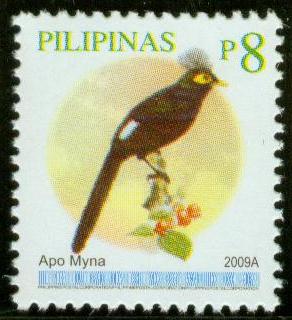
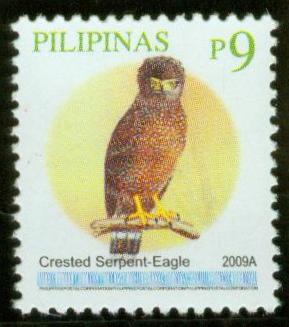
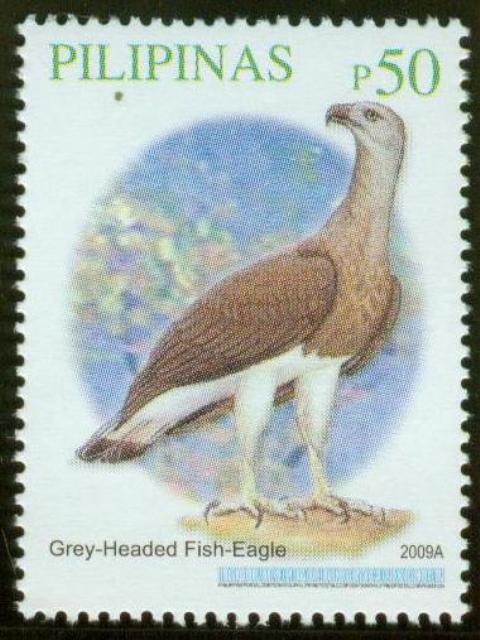
8p Apo Myna - Singles (100,000)
9p Crested Serpent Eagle - Singles (125,000)
50p Grey-headed Fish Eagle - Singles (35,000)
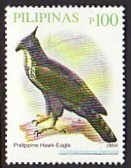
100p Philippine Hawk Eagle - Singles (35,000)
Design: All pictures taken from the book "A Guide to the Birds of the Philippines" by Robert S. Kennedy, Pedro C. Gonzales, Edward C. Dickinson, Hector C. Miranda, Jr., and Timothy H. Fisher.
First Day Covers: Manila
8p Apo Myna (Basilornis mirandus). Endemic to the Philippines. Its natural habitat is subtropical or tropical moist montane forests. It is becoming rare due to habitat loss. Several species have been introduced to areas like North America, Australia, South Africa and New Zealand, especially the Common Myna which is often regarded as an invasive species. Mynas are medium-sized passerines with strong feet. Their flight is strong and direct, and they are gregarious. Their preferred habitat is fairly open country, and they eat insects and fruit. (http://en.wikipedia.org/wiki/Apo_Myna)
9p Crested Serpent Eagle (Spilornis cheela or Kanmuri-washi). Is a bird of prey and like all eagles, it is in the family Accipitridae. The Philippine Serpent Eagle (S. holospila) is sometimes included here as a subspecies. The Crested Serpent Eagle can be found in a large geographical region from South Asia, including Pakistan, India and Sri Lanka, to Southeast Asia, extending to southern China and Indonesia. This forest bird nests in treetops near fresh water. Its nests are constructed with sticks and contain not more than a single egg at a time. ( http://en.wikipedia.org/wiki/Spilornis_cheela)
50p Grey-headed Fish Eagle (Ichthyophaga ichthyaetus). Is a bird of prey. Like all eagles, it is in the family Accipitridae. Grey-headed Fish Eagle breeds in southern Asia from India and Sri Lanka to south east Asia and the Philippines. It is a forest bird which builds a stick nest in a tree near water and lays two to four eggs. It is a largish stocky raptor at about 70-75cm in length. ( http://en.wikipedia.org/wiki/Grey-headed_Fish_Eagle)
100p Philippine Hawk Eagle. While only a medium-sized hawk-eagle, this inhabitant of the Philippines has a striking appearance due to its long crest of four or five feathers, up to seven centimetres long, protruding from its crown. The plumage on the upperparts is dark brown, and the dark brown tail is striped with four to five darker, narrow bands. The head and underparts are reddish-brown with black streaking, and the throat is whitish. The wings are broad and rounded and barred flight feathers can be seen in flight. http://www.arkive.org/philippine-hawk-eagle/spizaetus-philippensis/description.html
-
Birds