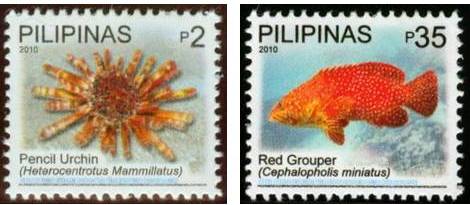
2010, July 15. Philippine Marine Biodiversity - Definitives
Litho Offset. Amstar Company, Inc. Perf. 13.5
Singles, Sheets of 100 (10 x 10)
2p - Pencil Urchin (3,346,600)
35p - Red Grouper (1,066,600)
Designer: Mary Ann C. Cruz
Graphic Artist: Earvin L. Ayes
Design Coordinators: Victorino Z. Serevo; Elenita D.L. San Diego
Source: Coral Reef Animals of the Indo-Pacific by Dr. Terence Gosliner
First Day Covers: Manila
PENCIL URCHIN (Heterocentrotus mammillatus). The Slate Pencil Urchin, also known as Red Slate Pencil Urchin, has a reddish-tan body with sparse, long, blunt solid spines that taper at the tips and radiate out from the body in all directions at lengths of up to five inches. In addition to its spines looking like pencils, this sea urchin is also called the Slate Pencil Urchin because its spines were used as writing utensils for slate boards. It can move about via its suctorial podia. It has enough traction to allow it to climb up the glass sides of an aquarium. Because of its large size, the Slate Pencil Urchin will require the solid construction of rocky reefs in the aquarium; rock pieces should be well placed to avoid accidental tumbling and moving around. It can be destructive and harmful to corals, but is safe in a fish-only aquarium. Slate Pencil Urchins are generally solitary, and it is generally best to keep just one of its kind per tank. Being nocturnal, it will usually hide during the day and wait for the cover of night to forage for algae. Live rock will provide a good source for grazing. The Slate Pencil Urchin prefers low nitrate levels and will not tolerate copper-based medications. It is not unusual for it to lose a few spines, but if it sheds quite a few of them, it is often due to poor water quality. (http://www.peteducation.com/article.cfm?c=16+2158+2220&aid=2130)
RED GROUPER (Cephalopholis miniatus). Red groupers are easily recognized by their color and by the sloped, straight line of their spiny dorsal fin. The fin has a long second spine and an unnotched interpine membrane. Most epinepheline groupers have a notched dorsal spine membrane and a third spine longer than the second. The body is deep brownish-red overall, with occasional white spots on the sides. Tiny black specks dot the cheeks and operculum. The red grouper is most closely related to the Nassau grouper, Epinephelus striatus, which has several vertical bars and blotches, and is found more commonly on coral reefs. It inhabits ledges, crevices, and caverns of rocky limestone reefs, and also lower-profile, live-bottom areas in waters 10 to 40 feet deep. The red grouper is a protogynous hermaphrodite, and females are capable of reproducing at 4 years of age. The maximum age of the red grouper is 25 years, with older fish reaching a size of 32.5 inches and 25 pounds. Red groupers usually ambush their prey and swallow it whole, proffering crabs, shrimp, lobster, octopus, squid and fish that live close to reefs. (http://www.safmc.net/FishIDandRegs/FishGallery/RedGrouper/tabid/313/Default.aspx
-
Marine Biodiversity
-
Marine Life